Happy Birthday Mister Darwin!

Charles Robert Darwin was born 210 years ago today, which seems like a long time to most humans.  That time is about a microsecond in the geologic time scale (GTS) that expresses the history of our planet.  Would Darwin be impressed by how far our understanding of life has evolved?

Darwin's Tree of evolutionIn 1837, Darwin wrote in his notes (see image) “I think case must be that one generation should have as many living as now. To do this and to have as many species in same genus (as is) requires extinction . Thus between A + B the immense gap of relation. C + B the finest gradation. B+D rather greater distinction. Thus genera would be formed. Bearing relation” (next page begins) “to ancient types with several extinct forms.”

To be fair, it is likely this thought had occurred to other people before this time, but were never published.  It took Darwin, twenty-two years to gather evidence and develop the idea and the courage to publish his most famous work On the Origin of Species by Means of Natural Selection, or the Preservation of Favoured Races in the Struggle for Life published on November 22, 1859.  In 1844, Darwin wrote to Joseph Dalton Hooker, “At last gleams of light have come, & I am almost convinced (quite contrary to opinion I started with) that species are not (it is like confessing a murder) immutable. Heaven forfend me from Lamarck nonsense of a “tendency to progression” “adaptations from the slow willing of animals…”

Darwin opened up a can of worms or should I say bacteria with his theory which is still being debated today.  Although the debate today is much different than in Darwin’s time.  So like life, knowledge evolves as well.  The tree of life looks much different than Darwin’s first drawing.

Modern tree of lifeWhat strikes me about this modern version of the tree of life is the dominance of bacteria. Bacteria are colored blue, eukaryotes red, and archaea green.  This shows the diversity in bacteria, it does not indicate the abundance of bacteria on earth where the biomass has been estimated to be greater that all plants and animals combined.  Another interesting fact about bacteria is they evolve at a rate that is observable in a short time-frame.  The video below shows bacteria evolving antibiotic resistance in a matter of days.

So the debate continues with many theories on how life evolves, but that is what science is all about, testing theories to find what is the best explanation of reality.

At the end of On the Origin of Species Darwin concluded that:

There is grandeur in this view of life, with its several powers, having been originally breathed into a few forms or into one; and that, whilst this planet has gone cycling on according to the fixed law of gravity, from so simple a beginning endless forms most beautiful and most wonderful have been, and are being, evolved.

“Evolved” in the quote above was the only mention of evolution in the first 5 editions of his book.  He finally added the word “evolution” to the sixth edition of his The Origin of Species in 1872 also removing “On” from the title.

Happy birthday to Charles Darwin and the Secular Hub (6 years old).

For more information see Wikipedia’s Portal:Evolutionary biology.

Truth isn’t Truth! Or is it?

Recently  Rudy Giuliani made the statement “truth isn’t truth” in an interview on Meet the Press. So how do we know what is true?  Learning how to think critically can help you get closer to the truth.  Exploring how you think and developing the skill of thinking critically can help cut through the hype of advertisers and politicians.

Critical thinking is disciplined thinking that is clear, rational, open-minded, and informed by evidence. It is a skill that can be learned and  needs to be studied and practiced to improve our thinking.

Brief History

Socrates lived in approximately 470 – 399 BC in Athens. He is regarded as the father of critical thinking for his development of the Socratic Method, a form of cooperative argumentative dialogue between individuals, based on asking and answering questions to stimulate critical thinking and to draw out ideas and underlying presumptions.

Rene Descartes lived (1596 – 1650) in France and the Dutch Republic. He was one of the notable intellectuals of the Dutch Golden Age. Descartes began a treatise about 1628, entitled Rules for the Direction of the Mind that was unpublished at the time of his death. A Dutch translation appeared in 1684. The first 12 rules deal with his proposed scientific methodology in general.  Analysts consider them to be early versions of principles that he expanded upon in his later writings.  His best known philosophical statement is “I think, therefore I am” (French: Je pense, donc je suis; Latin: Ego cogito, ergo sum), found in Discourse on the Method (1637) is a fundamental element of Western Philosophy. Descartes created the foundation for 17th Century rationalism. “Rationalism, in Western philosophy, the view that regards reason as the chief source and test of knowledge.”

John Dewey (1859 – 1952) was an American philosopher, psychologist, and educational reformer who recognized that a curriculum aimed at building thinking skills would benefit the individual learner, the community, and the entire democracy. Dewey’s ideas on education were to prepare students as “reflective, autonomous and ethical beings capable of arriving at social truths through critical and intersubjective discourse” opposed to “docile compliance with authoritarian work and political structures, discourage the pursuit of individual and communal inquiry, and perceive higher learning as a monopoly of the institution of education.” As an atheist and a secular humanist in his later life, Dewey was one of the original 34 signatories of the first Humanist Manifesto (1933).

The Process

There are about 175 cognitive biases are identified in the preceding graphic created from Wikipedia’s List of cognitive biases article. Buster Benson divided the Wikipedia list into four main issues:
1. Too Much Information
2. Not Enough Meaning
3. Need To Act Fast
4. What Should We Remember?

We need to mitigate cognitive biases to try to reduce their negative effects on our thinking.  In addition, the basic steps of critical thinking are:
1. Organize information
2. Structure reasoning
3. Consider evidence
4. Identify assumptions
5. Evaluate arguments
6. Communicate conclusion

More Resources

In addition to the links above, the following resources are just suggestions (not endorsements) of where to get more information about and of critical thinking.  If you find any other resources, use our contact page to send me a link.

Books that I have found about critical thinking.  I have not read all of them cover to cover, but used all of them in my research. I also provide links to search the WorldCat to find the books at your local library and Amazon.com to purchase the book.  The Amazon.com link is associated with the Secular Hub and if you purchase using that link, the Secular Hub will receive 4.5% of the selling price from Amazon.

  • Critical Thinking Skills For Dummies by Martin Cohen  WorldCat  Amazon
  • A Field Guide To Lies by Daniel J. Levitin  WorldCat  Amazon
  • Six Thinking Hats by Edward De Bono  WorldCat   Amazon
  • Thinking, Fast And Slow by Daniel Kahneman  WorldCat  Amazon
  • How To Solve It by G. Polya  WorldCat  Amazon
  • Nudge: Improving Decisions About Health, Wealth, and Happiness by Richard H. Thaler and Cass R. Sunstein  WorldCat  Amazon
  • Skeptic: Viewing the World with a Rational Eye by Michael Shermer  WorldCat  Amazon

National Day of Reason

Let’s start with a prayer a poem by Kevin Young, Ode to Big Pun

I’m not a prayer
I just wish a lot

Wishful thinking maybe just as bad as prayer at achieving specific results.  Maybe prayer is just ritualized wishful thinking?  Or maybe prayer is a mashup of wishful thinking and meditation.  There has been some research about the effects of praying and there doesn’t seem to be much benefit.

As Daniel Dennett stated in the Portable Atheist, “Surely it does the world no harm if those who can honestly do so pray for me! No, I’m not at all sure about that. For one thing, if they really wanted to do something useful, they could devote their prayer time and energy to some pressing project that they can do something about.”

Back to the reason (pun intended) I am writing this post.  Reason is the capacity for consciously making sense of things, establishing and verifying facts, applying logic, and changing or justifying practices, institutions, and beliefs based on new or existing information.  Sounds like a useful thing to do.

Easier said than done.  We are inundated by so much information, it is difficult to separate facts from fake news.  That is where critical thinking comes to the rescue!  Unfortunately this skill is not taught in U.S. public schools like it is in other parts of the world.   John Dewey is one of many educational leaders who recognized that a curriculum aimed at building thinking skills would benefit the individual learner, the community, and the entire democracy.  So I used Dewey’s system to find some resources at the Denver Public Library about critical thinking such as Critical thinking skills success in 20 minutes a day and A field guide to lies : critical thinking in the information age along with several hundred others.

I think it is the duty and responsibility of every citizen to promote the development and application of reason, not just today but everyday!

Earth the First Frontier

Earth, third rock from the Sun, our home for at least a few million or billion years (depending on when you start the clock) and the next 4 or 5 billion years…I hope. The Earth was our first universe until we realized there was more out there and here on Earth.

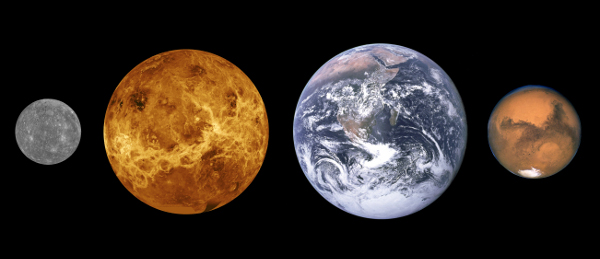
Terrestrial planets image
Relative sizes of Mercury, Venus, Earth, and Mars

Earth’s axis of rotation is tilted with respect to its orbital plane, producing seasons on the Earth. The gravitational interaction between the Earth and relatively large Moon causes ocean tides and stabilizes the Earth’s orientation on its axis. Earth is the densest planet in the Solar System and the largest of the four terrestrial planets.

Earth’s interior remains active and hot with a solid iron inner core (5,400 °C), a  molten liquid outer core (2,730–4,230 °C) that generates a magnetic field that extends far out into space. The Earth’s magnetic field serves to deflect most of the solar wind, whose charged particles would otherwise strip away the ozone layer that protects the Earth from harmful ultraviolet radiation.  Combined with all the water and atmosphere, it makes Earth a relatively comfortable and safe place for life to evolve.

Apollo 17 view of Earth

Life began in the ocean over 3.5 billion years ago and evolved into the complex tree of life we see today.  In 2016, researchers estimated that there might be 1 trillion species currently on Earth with only one thousandth of 1 percent (0.001%) identified/classified by us.  This is up from 10-14 million estimated in 2012.  Those numbers do not account for all the species that have already disappeared from the Earth.  Some estimates are 99% of all species that ever lived on Earth are extinct, but that is very difficult to verify.

There is only ONE global ocean covering approximately 71% of Earth’s surface and 90% of the Earth’s biosphere. The global ocean has been geographically divided into distinct named regions. The boundaries between these regions have evolved over time for a variety of historical, cultural, geographical, and scientific reasons.  Most of the ocean is unexplored — about 95 percent of this underwater realm is unseen by human eyes.  The world ocean is the habitat of 230,000 known species, but because much of it is unexplored, the number of species that exist in the ocean is much larger.

Out of sight does not mean we (humans) do not have a huge impact on the ocean.  The ocean is a vast source of food, but we are depleting the fish stocks with modern fishing methods.  We dump our waste into the ocean, thinking it will disappear.  Since 1996, NOAA has removed 904 tons of debris from Papahānaumokuākea Marine National Monument in Hawaii including 57 tons from a 2014 mission.

Over 7.6 billion humans live on Earth and depend on its biosphere and natural resources for their survival.  We must learn how to care for this ecosystem before we try to create an artificial one on another planet, otherwise we will be doomed anywhere else and on Earth.

Sources and more about the Earth:

https://en.wikipedia.org/wiki/Earth
http://www.noaa.gov/oceans-coasts
https://en.wikipedia.org/wiki/Ocean
http://tolweb.org/tree/phylogeny.html
Tree of Life Explorer at http://www.onezoom.org/
https://visibleearth.nasa.gov/view_cat.php?categoryID=1484
https://en.wikipedia.org/wiki/Extinction

Nevertheless, She Persisted

Wall Street owns the country. It is no longer a government of the people, by the people, and for the people, but a government of Wall Street, by Wall Street and for Wall Street….

A quote by Senator Elizabeth Warren? It sounds a lot like her, but this quote was from 1890, by a woman that sounds just as passionate as Senator Warren! Mary Elizabeth Lease was an American lecturer, writer and political activist. She was also known as “Mother Lease” by her supporters and “Mary Yellin” by her enemies. Born in Pennsylvania in 1850 to Irish parents, Lease became a school teacher in Kansas in 1870. She and her husband, a pharmacist, spent ten years trying to make a living farming, but finally gave up in 1883 and settled in Wichita.

She was a powerful public speaker, for the Populist Party, that connected with Kansas farmers, who were rebelling against high mortgage interest and railroad rates. She was loved by farmers and labor unions, while the press and the major party politicians criticized her unmercifully. Nevertheless, she persisted and made more than 160 speeches for the Populist cause, campaigning all over Kansas, as well as the Far West and the South.

Even though Lease split with the Populist Party starting in 1893 (they were defeated in 1984) she felt with the election of Theodore Roosevelt and the national drive for reforms she advocated years earlier:

In these later years I have seen, with gratification, that my work in the good old Populist days was not in vain. The Progressive party has adopted our platform, clause for clause, plank by plank. Note the list of reforms which we advocated which are coming into reality. Direct election of senators is assured. Public utilities are gradually being removed from the hands of the few and placed under the control of the people who use them. Women suffrage is now almost a national issue . . . The seed we sowed out in Kansas did not fall on barren ground.

picture of Mary LeaseIf we can learn anything from Mary Elizabeth Lease, it is to be successful we need to persist!  She did this all before women could vote! Take note, high school students all over America.

References:
https://en.wikipedia.org/wiki/Mary_Lease
http://gildedage.lib.niu.edu/islandora/object/niu-gildedage%3A24027
https://www.kshs.org/p/kansas-historical-quarterly-the-disaffection-of-mary-elizabeth-lease/17865
http://www.historyisaweapon.com/defcon1/marylease.html
http://historymatters.gmu.edu/d/5304/
http://historymatters.gmu.edu/d/5303

.

.

.

.

My opinion (Dirk) is below. If you are not interested or reactionary or not a critical thinker, do not scroll down!

.

.

.

.

.

.

.

Nothing to see here.

.

.

Tonight on Sixty Minutes there was an interesting interview with Stormy Daniels. Thank you for not being a victim. Keep persisting! #KeepPersisting

And in the interest of not being sexist, go Giannis! What an immigrant!  Thanks for coming to America!

Dr. Justina Ford – Medical Pioneer of Colorado

As the first African-American woman to be licensed as a physician in Colorado, Dr. Justina Laurena Ford overcame both gender and racial barriers to practice her profession. Even in 1950, she was still the only black woman physician in Colorado.

As the first African-American woman to be licensed as a physician in Colorado, Dr. Justina Laurena Ford overcame both gender and racial barriers to practice her profession.  Even in 1950, she was still the only black woman physician in Colorado.

Dr. Ford was born Justina Laurena Warren in Knoxville, Illinois in 1871.  In 1892, she married Baptist minister John Ford and moved to Chicago, where she graduated from the Hering Medical College in 1899.
Justina Ford
In 1902, Dr. Ford moved to Denver’s Five Points neighborhood and applied for a medical license.  When she applied for her license to practice medicine, she was told by the clerk, “I feel dishonest taking a fee from you. You’ve got two strikes against you to begin with. First of all, you’re a lady, and second, you’re colored.” Ford often referred to this double barrier to her career. In her later years, she said, “I fought like a tiger against those things.”  She set up a private practice in her home, since African-Americans were barred at the time from working in hospitals or joining the Colorado Medical Association.

Dr. Ford managed to establish a long and notable practice from her home, specializing in gynecology, obstetrics, and pediatrics, despite all the obstacles.  Ford continued caring for patients until two weeks before her death on October 14, 1952 and by the end of her life she had delivered almost 7,000 babies. In 1950, she was allowed to join the the Colorado and American Medical Associations and practice at the Denver General Hospital and was admitted to the Denver Medical Society.
Dr. Ford's home
Dr. Ford was admitted to the Colorado Women’s Hall of Fame in 1985 and was named a “Medical Pioneer of Colorado” by the Colorado Medical Society in 1989. In 1998, a sculpture of Ford holding a baby, made by Jess E. DuBois, was erected outside her house. The home (3091 California St.) where Dr. Ford lived and worked has been turned into the Black American West Museum & Heritage Center where you can find out more about this amazing woman.