
Peace and Social Justice: A Humanist Perspective

Continuing our exploration of the Ten Commitments, I take a look at Peace and Social Justice. True peace involves an intense commitment to social justice and affirms the human rights and personal autonomy of all people.

In an age marked by global conflict, deep social divides, and systemic inequality, the call for peace and social justice resonates more urgently than ever. From the humanist perspective, these are not abstract ideals or distant dreams—they are essential components of a moral, meaningful life rooted in reason, compassion, and shared humanity.

Humanism

Humanism is a worldview that emphasizes human dignity, autonomy, and interconnectedness. It relies on reason, evidence, and empathy—not dogma or divine authority—to shape ethical behavior. In this light, peace and social justice are not optional extras, but moral imperatives. They are how we build a society where every person can thrive.

Humanists reject fatalism and apathy. They believe that human beings have the capacity—and the responsibility—to create a better world. This includes addressing injustice, promoting equity, and resolving conflicts through dialogue and cooperation rather than violence or coercion.

Peace Beyond the Absence of War

To a humanist, peace is not merely the absence of conflict. It is the presence of conditions that make life worth living: security, opportunity, mutual respect, and fairness. Peace is sustainable only when people have their basic needs met—when they are free from fear, oppression, and exploitation.

This is why humanists often champion international cooperation, disarmament, diplomacy, and human rights. They believe that creating peace means dismantling the roots of violence—whether economic inequality, ethnic division, religious extremism, or political tyranny.

Social Justice as a Moral Mandate

Social justice is the pursuit of a society where power, resources, and opportunities are equitably shared. Humanism, with its focus on individual dignity and collective well-being, naturally aligns with this vision. It demands that we challenge structures that perpetuate poverty, racism, sexism, ableism, ageism, and other forms of systemic discrimination.

Humanists support policies and movements that protect workers, uplift marginalized communities, defend civil liberties, and ensure access to education, healthcare, and housing. These are not just political positions—they are expressions of the belief that every human being matters equally.

Action, Not Just Intention

Humanism is not a passive philosophy. It calls for action: informed, ethical, and inclusive. Whether through grassroots activism, civic engagement, education, or technological innovation, humanists are compelled to translate their values into impact.

Promoting peace and justice doesn’t require perfection—it requires persistence, humility, and a willingness to listen and grow. It involves working across differences, acknowledging past wrongs, and striving to repair and rebuild with integrity.

A Vision for the Future

A humanist vision of peace and social justice is one where humanity recognizes its shared destiny. It is a world where we protect the vulnerable, resist tyranny, and replace hatred with understanding. It is a world shaped not by divine decree, but by the conscious, collective effort of people who believe in each other.

In a time of uncertainty, this vision offers clarity. In a world of division, it offers unity. And in the face of despair, it offers hope—anchored not in fantasy, but in our common capacity to care and to act.

Conclusion

Peace and social justice are not destinations; they are ongoing commitments. Every act of fairness, every moment of compassion, and every stand against injustice brings us one step closer to the world we seek to build.

And that world, though imperfect, is still within reach—if we choose to create it, together.

The Universal Peace Symbol image is from Wikimedia Commons and consists of four images showing the evolution from a Sun-Earth Lagrange Point diagram to a Universal Peace Symbol.
The Scopes Trial: When Science Went on Trial

100 years ago, in July 1925, Dayton, Tennessee, a sleepy rural town, became the epicenter of a dramatic showdown over science, religion, and education. What was meant to be a modest legal test balloon turned into a national—and international—spectacle. (Encyclopedia Britannica, HISTORY)

The Butler Act: Setting the Stage

The spark was the Butler Act, passed in March 1925 by Tennessee lawmakers. This law made it a misdemeanor for public school teachers to teach that humans evolved from lower animals, directly contradicting the Biblical creation story. Violators could be fined between $100-500. (Wikipedia)

A Town’s PR Stunt

Local business leaders and school officials in Dayton deliberately sought a test case to draw attention. They recruited John T. Scopes—a 24‑year‑old science teacher who typically taught math and physics—to admit teaching evolution. He was arrested, and the media storm began. (TLSA)

The Players Enter the Fray

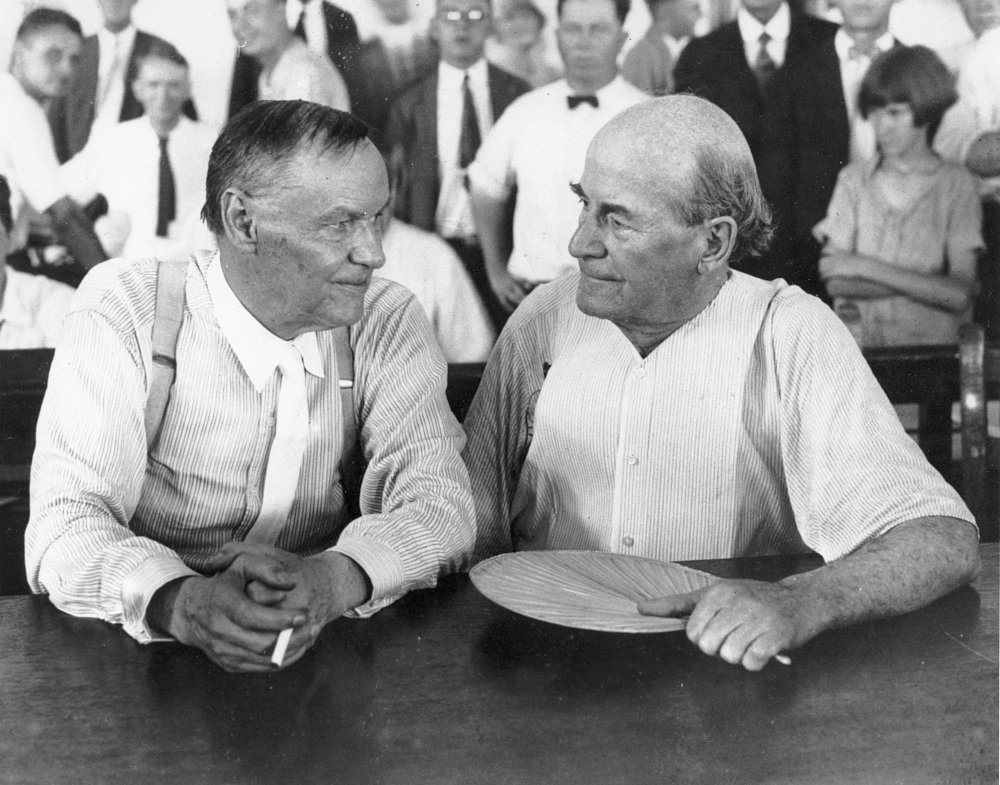
Picture of Darrow and Bryan
Clarence Darrow (left) and William Jennings Bryan (right) during the Scopes Trial in 1925.
  • Prosecution: William Jennings Bryan, celebrated orator and three‑time Democratic presidential nominee, championed biblical literalism. He argued evolution threatened religious moral order. (American Civil Liberties Union)
  • Defense: Clarence Darrow, renowned defense attorney and ACLU member, took up Scopes’s defense pro bono, seeking to challenge the Butler Act under the Constitution. (American Civil Liberties Union)

A Media Circus

Dubbed the “trial of the century,” the case drew over a thousand spectators, hundreds of reporters, and even broadcasts on live radio—America’s first. Dayton was flooded with journalists, thrill‑seekers, and circus‑like attractions. (HISTORY)

Courtroom Drama

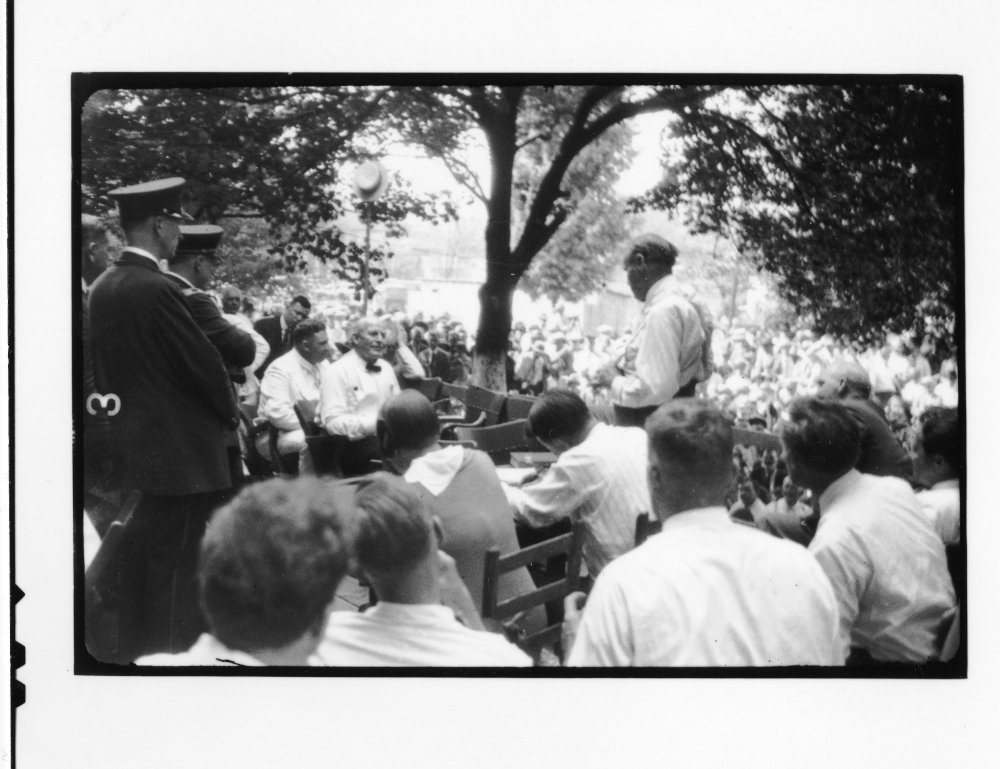
Picture of outdoor proceedings of Scopes Trial
Because of the extreme heat, Judge Raulston moved court proceedings outdoors
  • The trial began on July 10, housed in the Rhea County Courthouse under sweltering heat. (HISTORY)
  • The judge forbade scientific expert testimony. In a bold move, Darrow called Bryan himself to the stand, forcing him into a cross-examination over his interpretation of the Bible—a media moment that became legend. (American Civil Liberties Union)
  • Darrow even asked the jury to find Scopes guilty so the defense could immediately appeal. On July 21, 1925, after less than nine minutes of deliberation, the jury did so, and Scopes was fined $100. (PBS)

Aftermath: Verdicts, Appeals, Legacies

  • Scopes’s conviction was overturned in 1927 on a technicality (the judge imposed the fine, not the jury). But the Butler Act itself was upheld—and remained law until its repeal in 1967. (HISTORY)
  • Bryan died just five days after the trial, reputedly worn out by the ordeal. Darrow, meanwhile, had helped shift public sentiment—many saw Scopes and his supporters as moral victors. (American Civil Liberties Union)

Cultural Significance & Ongoing Relevance

  • The trial highlighted a deeper conflict between modernism and fundamentalism, between urban progress and rural conservatism. It changed perceptions about academic freedom and the proper role of religion in public schools. (Live Science)
  • Its legacy endures. The debate over teaching evolution—or more religious perspectives—continues in many parts of the U.S., with fresh controversies in states like West Virginia, Texas, and Louisiana. (AP News)

Myth vs. Reality

Popular dramatizations like Inherit the Wind (1955 play and 1960 film) took liberties that altered key details for dramatic effect—such as creating fictional characters and exaggerated confrontations. While they brought the story to a mainstream audience, historians emphasize the importance of distinguishing fact from fiction. (Wikipedia, The Christian Science Monitor, Live Science)

Conclusion

The Scopes trial transcended a small‑town legal skirmish—it became a defining moment in American cultural history, plotting the turbulent crosscurrents between science, religion, law, and media. Though Scopes lost the verdict, the broader argument was won for evolution and academic freedom. Its echoes still shape debates on education and belief in the 21st century. (AP News)