
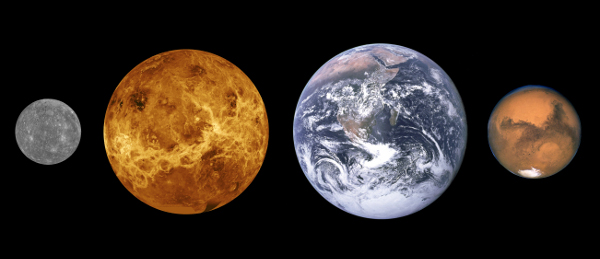
Earth’s axis of rotation is tilted with respect to its orbital plane, producing seasons on the Earth. The gravitational interaction between the Earth and relatively large Moon causes ocean tides and stabilizes the Earth’s orientation on its axis. Earth is the densest planet in the Solar System and the largest of the four terrestrial planets.
Earth’s interior remains active and hot with a solid iron inner core (5,400 °C), a molten liquid outer core (2,730–4,230 °C) that generates a magnetic field that extends far out into space. The Earth’s magnetic field serves to deflect most of the solar wind, whose charged particles would otherwise strip away the ozone layer that protects the Earth from harmful ultraviolet radiation. Combined with all the water and atmosphere, it makes Earth a relatively comfortable and safe place for life to evolve.

Life began in the ocean over 3.5 billion years ago and evolved into the complex tree of life we see today. In 2016, researchers estimated that there might be 1 trillion species currently on Earth with only one thousandth of 1 percent (0.001%) identified/classified by us. This is up from 10-14 million estimated in 2012. Those numbers do not account for all the species that have already disappeared from the Earth. Some estimates are 99% of all species that ever lived on Earth are extinct, but that is very difficult to verify.
There is only ONE global ocean covering approximately 71% of Earth’s surface and 90% of the Earth’s biosphere. The global ocean has been geographically divided into distinct named regions. The boundaries between these regions have evolved over time for a variety of historical, cultural, geographical, and scientific reasons. Most of the ocean is unexplored — about 95 percent of this underwater realm is unseen by human eyes. The world ocean is the habitat of 230,000 known species, but because much of it is unexplored, the number of species that exist in the ocean is much larger.
Out of sight does not mean we (humans) do not have a huge impact on the ocean. The ocean is a vast source of food, but we are depleting the fish stocks with modern fishing methods. We dump our waste into the ocean, thinking it will disappear. Since 1996, NOAA has removed 904 tons of debris from Papahānaumokuākea Marine National Monument in Hawaii including 57 tons from a 2014 mission.
Over 7.6 billion humans live on Earth and depend on its biosphere and natural resources for their survival. We must learn how to care for this ecosystem before we try to create an artificial one on another planet, otherwise we will be doomed anywhere else and on Earth.
Sources and more about the Earth:
https://en.wikipedia.org/wiki/Earth
http://www.noaa.gov/oceans-coasts
https://en.wikipedia.org/wiki/Ocean
http://tolweb.org/tree/phylogeny.html
Tree of Life Explorer at http://www.onezoom.org/
https://visibleearth.nasa.gov/view_cat.php?categoryID=1484
https://en.wikipedia.org/wiki/Extinction